Author Archives: kirkscorner

Week 6

The weather is definitely against us.  Fortunately, I have great students who really want to learn, and our Kik conversation goes wild at the oddest of times.

Since I was late in posting Week 5, I wanted to wait to post Week 6 so I could see what was done in my absence and try to build that into the weekly plans.  Monday went well, but Tuesday was a snow day.  As such, I’m glad I waited because you get to see how I change my weekly structures to make up for lost instructional time. As you read this post, know that Monday, Wednesday, and Thursday are exactly as it went.

Now, before reading, my formatting was to take the weekly plan I have to submit to administration and paste it into the blog.  That became confusing to a reader who contacted me and suggested I change that up a bit to be more reading friendly.  Sure thing.  Hope this helps.


Monday:

Bell Ringer: Through the study of Little Red Riding Hood, students will be able to monitor GUM and identify the meaning of unknown words.

Hidden Agenda: Building background for allusion

Bell Ringer: 15 minutes

  • Caught ‘Ya (L11.1-3)
  • Etymology (L11.4-6)

~ G/AF: Sentence Corrections with guided questions with assigned weekly partner

~ Share outs (based on pacing)


Etymology and GUM Quiz: Students will take the assessment for the week’s vocabulary.

  • Etymology Quiz (20ish minutes)


Multiple Choice Monday: Through the study of an AP MC reading selection, students will be able to correctly answer the question, including justification for the selected answer.

  • Multiple Choice Monday: Released AP Exam 2008 MCQuestions

I: Student are given 15 minutes to read the text and answer the questions. (Ss may select one final answer or one of two for half credit.)

D/Ap: Students will review answers and write corrections with argumentative stem for homework in order to earn back some of the missing points.

  • Reflection Closure:

What do you notice about how you are beginning to answer questions in the MC testing? What will be a strength to help you? What will be an area to work on before the test?


HWK: Read and annotate “The Declaration of Independence”


Tuesday: No school.


Wednesday

Bell Ringer: Through the study of Little Red Riding Hood, students will be able to monitor GUM and identify the meaning of unknown words.

Hidden Agenda: Building background for allusion

Bell Ringer: 15 minutes

  • Caught ‘Ya (L11.1-3)
  • Etymology (L11.4-6)

~ G/AF: Sentence Corrections with guided questions with assigned weekly partner

~ Share outs (based on pacing)


First Turn, Last Turn: Students will use the cooperative First Turn, Last Turn structure to read and discuss “The Declaration of Independence” to ensure student comprehension.

First Turn, Last Turn:

  1. Students will have read and annotated the text the previous night for homework.
  2. Students will create three questions from the text.
  3. Students will group based on the number on their handout to talk about the sentence that stands out the most in the text.
  4. The class will openly discuss three of the student questions that have been selected by the teacher.

Video Summary: Too Late to Apologize

  • Students will have 3 minutes for a quick response using the TIQA formatting: Is it too late?


Diction and Tone: Through the review of diction and tone, students will be able to identify and analyze tone of specific text examples.

What we’re learned review: Diction and Tone Analysis of “The Declaration of Independence”

~ Students will select the four examples from the text that stand out the most and identify elements of diction making this an effective statement. Students will then use short response to determine the tone of the text using these four examples for justification.


Rhetorical Appeals: Through the review of ethos, logos, and pathos, students will be able to identify and analyze appeals included in the text.

What we’re learned review: What is ethos, logos, and pathos? Review foundational knowledge from previous classes through Shmoop instructional video.


HWK: Identify a minimum of two of each of the appeals in “The Declaration of Independence”


Thursday

Bell Ringer: Through the study of Little Red Riding Hood, students will be able to monitor GUM and identify the meaning of unknown words.

Hidden Agenda: Building background for allusion

Bell Ringer: 15 minutes

  • Caught ‘Ya (L11.1-3)
  • Etymology (L11.4-6)

~ G/AF: Sentence Corrections with guided questions with assigned weekly partner

~ Share outs (based on pacing)

Task Card Review: Through the study of the Declaration of Independence, the students will be able to justify the rhetorical appeal in a given text.

  • Students are given a random quote from the text.
  • T will model guided questions for labeling and justifying the rhetorical appeal.
  • Ss will apply guided questions on their own.  T will verify student respses.
  • Ss will be assigned a partner for the Sage and Scribe grouping technique.
  • Ss will submit both quotes and homework.

Rhetorical Devices Reteaching: Through the study of The Declaration of Independence, the students will be able to label and analyze the use of rhetorical devices and the audience impact.

  • Discussion: What are the devices? What do these words mean?
  • T models guided questions for identification and determining meaning.
  • Examples Quiz: Students were given examples to pair with the terms as though it were a timed quiz.
  • Ss find examples within the text.

HWK: Students to find 3 rhetorical devices in the text.


Friday: No school.


Week 5 – And illness takes hold.

Week 5 came with a plan, but you know what they say about that.  The second semester always seems the hardest, given snow days and flu season. Generally, I do fairly well, but this week…


  Standards/Objectives Detailed Agenda
W5

M

Bell Ringer: Through the study of fairytales, students will be able to monitor GUM and identify the meaning of unknown words.

Hidden Agenda: Building background for allusion


Etymology and GUM Quiz: Students will take the assessment for the week’s vocabulary.


Multiple Choice Monday: Through the study of an AP MC reading selection, students will be able to correctly answer the question, including justification for the selected answer.


Bell Ringer: 15 minutes

Caught ‘Ya (L11.1-3)

Etymology (L11.4-6)

~ G/AF: Sentence Corrections with guided questions with assigned weekly partner

Etymology Quiz (20ish minutes)

Multiple Choice Monday: Released AP Exam 2008 MCQuestions

I: Student are given 15 minutes to read the text and answer the questions.

(Ss may select one final answer or one of two for half credit.)

D/Ap: Students will review answers and write corrections with argumentative stem as homework to earn back half of the missing points. (15 minutes)

Reflection Closure:

1. What do you notice about the MC testing? What will be a strength to help you? What will be an area to work on before the test?

2. How does last semester’s learning seem to fit into what you now know about this course?

Discuss Euthanasia to prepare for the library lesson. (Share out from Sunday News, Monday Views handout activity.)

W5

T

Bell Ringer: Through the study of fairytales, students will be able to monitor GUM and identify the meaning of unknown words.


Cycle 2: Class lesson on ethics by Mr. Goff in the library.


Bell Ringer: 15 minutes

Caught ‘Ya (L11.1-3)

Etymology (L11.4-6)

~ G/AF: Sentence Corrections with guided questions with assigned weekly partner

~ Share outs (based on pacing)


Ethics Overview: Class will meet in the library for Mr. Goff’s Ethic Overview Lesson.

HWK: Take your planning sheet from the debate activity and write an essay to explain your position.


W5

W

Bell Ringer: Through the study of fairytales, students will be able to monitor GUM and identify the meaning of unknown words.


Writing Wednesday: Through the study of The Art of Styling Sentences, students will be able to write thorough and concise sentences.


First Turn, Last Turn: Students will use the cooperative First Turn, Last Turn structure to read and discuss “The Crisis” to ensure student comprehension.


Diction and Tone: Through the review of diction and tone, students will be able to identify and analyze tone of specific text examples.


Bell Ringer: 15 minutes

Caught ‘Ya (L11.1-3)

Etymology (L11.4-6)

~ G/AF: Sentence Corrections with guided questions with assigned weekly partner

~ Share outs (based on pacing)


Writing Wednesday: Sentence Pattern 3

O: Ss learn sentence pattern one through short writing lecture.

D/Ap: Ss will create sentences using the pattern by arranging groups of words and when starting from scratch. Mastery 2/3 in each group.


First Turn, Last Turn:

1.     Students will read and annotate the text.

2.     Students will create three questions from the text.

3.     Students will group based on the number on their handout to talk about the sentence that stands out the most in the text.

4.     The class will openly discuss three of the student questions that have been selected by the teacher.


What we’re learned review:

Diction and Tone Analysis of “The Crisis”

HOMEWORK: SOAPSTone of “The Crisis”

Closure: Think about your answers and T’s answers.   What do you notice? What did you do well? What changes might you need to make?

W5

Th

Bell Ringer: Through the study of fairytales, students will be able to monitor GUM and identify the meaning of unknown words.


Tutoring Thursday: Through the study of AP Rhetoric, students will be able to correctly identify and explain the given device in the task cards. (Mastery 8/10)


Cycle 3: Through the study of The Crisis, students will be able to identify and analyze rhetoric in “The Crisis”.


Bell Ringer: 15 minutes

Caught ‘Ya (L11.1-3)

Etymology (L11.4-6)

~ G/AF: Sentence Corrections with guided questions with assigned weekly partner

~ Share outs (based on pacing)


Tutoring Thursday: AP Rhetoric Task Cards

I: Student are given 10 minutes to review the academic vocabulary associated with the excerpts on the task cards.   This is designed to help reteach missed skills, and definitions of unknown words are encouraged for learning outside of class.

D/Ap: Students will rotate through stations to complete a minimum of ten task cards each for a grade. Mastery = 8 of 10.


Rhetorical Analysis

1. Students are given the text of “The Crisis” to look for 8 rhetorical elements.

2. Students are to analyze how the included device affects the audience of the text.


W5

F

Bell Ringer: Through the study of fairytales, students will be able to monitor GUM and identify the meaning of unknown words.


Free Response Friday: Through the study of The Crisis, the student will be able to write a short response to a given prompt.


Sunday News, Monday Views: Through the study of current events, students will be able to rhetorically analyze a chosen article from the weekend news.

~Note: This assignment is weekend homework due at the start of EVERY Monday.


Bell Ringer: 15 minutes

Caught ‘Ya (L11.1-3)

Etymology (L11.4-6)

~ G/AF: Sentence Corrections with guided questions with assigned weekly partner

~ Share outs (based on pacing)


Free Response Friday: Students will respond to an essay question as much as possible with a 15 minutes time frame.

1. Students will review the text and analyze the prompt.

2. Students will create a quick outline.

3. Students will begin writing their response.


Weekly Homework Assignment of Sunday News, Monday Views:

O: Ss will learn the assignment expectations.

D/App: Students will pick an article and complete the analysis.

E: Ss will share with a partner for feedback (5 minutes each) and make revisions before submission (6).


HWK: Students will use article from Mr. Goff to prepare for ethics overview.


So what really happened?

Monday and Tuesday went without a hitch.  We hit a stumbling block on Wednesday with the sentence patterns, and we needed a bit more practice.  Additionally, some of the students were still really into the debate from the previous lesson.

Rather than read “The Crisis” we moved to “The Declaration of Independence” because I found out this was not read during the U. S. History course of study.  This also would give time to review rhetorical appeals since it is so overwhelmingly present in the text.

However, I ended up being sent home sick on Wednesday, and couldn’t make it in Thursday or Friday. Those who know me know I will always go in and try because even on my worst day, I’m better than some teachers.  This time, I was so out of it the students had to complete the emergency lesson plans and I actually lost a few days.

My Emergency Lesson Plans are pretty generic because the idea is that in 8 years I have never actually had to use them.  Basically, there is an article for students to read from NewsELA.  These articles can be scaled for reading levels, and they come with questions and writing prompts if you enter it in the search field.  Need an emergency plan for yourself?  Students are trained to read and annotate for understanding and then answer the multiple choice questions.  We complete a SOAPSTone analysis for everything we read, so that gave good practice. I added completing an MLA citation on the bottom a few weeks back, so most students added that out of habit.

Have you tried NewsELA? You should. https://newsela.com/


Week 4: Snow Week Redo

Well, as most of the nation knows (and world judging by BBC coverage), we didn’t have much school this week.  Therefore, you have no posted plans for Week 3.  This works well as it was a short week with diagnostic testing, but those things still have to be done.  Instead, we get to shift around a little bit and use most of Week 3 for Week 4.

  Standards/Objectives Detailed Agenda
W3

M

Bell Ringer: Through the study of “Hansel and Gretel” students will be able to monitor GUM and identify the meaning of unknown words.


Prepare for Library Lesson: Discussion of Sunday News, Monday Views with assigned text.


Assessment: Students will take the English III Placement and Diagnostic Test Part 1: Multiple choice.


Bell Ringer: 15 minutes

Caught ‘Ya (L11.1-3)

Etymology (L11.4-6)

~ G/AF: Sentence Corrections with guided questions with assigned weekly partner

~ Share outs (based on pacing)


Reteaching: Students will use library text to understand expectations of Sunday News, Monday Views Journaling expectations.

1. Students will have 10 minutes to answers the assigned questions.

2. Students will partner check their responses and identify the best response out of the two options.

3. Students will post answers and carousel through classroom responses.

4. Students will take worksheet home to process and revise before submission.


Assessment (30 minutes): Students will use the remainder of the block to complete the placement and diagnostic assessment.


W3

T

Bell Ringer: Through the study of “Hansel and Gretel” students will be able to monitor GUM and identify the meaning of unknown words.


Assessment: Students will take the English III Placement and Diagnostic Test Part 2: Written Response


Bell Ringer: 15 minutes

Caught ‘Ya (L11.1-3)

Etymology (L11.4-6)

~ G/AF: Sentence Corrections with guided questions with assigned weekly partner

~ Share outs (based on pacing)


Assessment: Students will use the remainder of the block to complete the placement and diagnostic writing assessment.


W3

W

Bell Ringer: Through the study of “Hansel and Gretel” students will be able to monitor GUM and identify the meaning of unknown words.


Writing Wednesday: Through the study of The Art of Styling Sentences, students will be able to write thorough and concise sentences.


Bell Ringer: 15 minutes

Caught ‘Ya (L11.1-3)

Etymology (L11.4-6)

~ G/AF: Sentence Corrections with guided questions with assigned weekly partner

~ Share outs (based on pacing)


Writing Wednesday: Sentence Pattern 2

O: Ss learn sentence pattern one through short writing lecture.

D/Ap: Students will identify S/V of the sentences to label the pattern and create their own example…

1. From vocabulary

2. From rhetorical précis of assigned text

3-5. From evaluating visual rhetoric in political cartoons.

Evaluate: Ss will create sentences using the pattern by arranging groups of words and when starting from scratch. Mastery 2/3 in each group.


W3

Th

Bell Ringer: Through the study of “Hansel and Gretel” students will be able to monitor GUM and identify the meaning of unknown words.


Tutoring Thursday: Through the study of AP Rhetoric, students will be able to correctly identify and explain the given device in the task cards. (Mastery 8/10)


Cycle 3: Class lesson on ethics by Mr. Goff in the library.


Bell Ringer: 15 minutes

Caught ‘Ya (L11.1-3)

Etymology (L11.4-6)

~ G/AF: Sentence Corrections with guided questions with assigned weekly partner

~ Share outs (based on pacing)


Tutoring Tuesday: AP Figurative Language Task Cards

I: Student are given 10 minutes to review the academic vocabulary associated with the excerpts on the task cards.   This is designed to help reteach missed skills, and definitions of unknown words are encouraged for learning outside of class.

D/Ap: Students will rotate through stations to complete a minimum of ten task cards each for a grade. Mastery = 8 of 10.


Vocab Assessment: Students will take a multiple choice assessment matching examples to the figurative language terms.


Ethics Overview: Class will meet in the library for Mr. Goff’s Ethic Overview Lesson.


W3

F

Bell Ringer: Through the study of the fairy tale, students will be able to monitor GUM and identify the meaning of unknown words.


Academic Recap: Through the study of Lincoln’s 2nd Inaugural Address, students will be able to analyze the diction and language, including the effect in the audience.


Sunday News, Monday Views: Through the study of current events, students will be able to rhetorically analyze a chosen article from the weekend news.

~Note: This assignment becomes weekend homework due EVERY Monday.


Bell Ringer: 15 minutes

Caught ‘Ya (L11.1-3)

Etymology (L11.4-6)

~ G/AF: Sentence Corrections with guided questions with assigned weekly partner

~ Share outs (based on pacing)


Review Lincoln’s Speech: Students will review the text and their notes on the overall tone.

1. Students will complete a SOAPSTone Analysis on the text.

2. Student group A will look for figurative language and analyze the effect on the audience.

3. Students group B will look for rhetorical appeal and analyze the effect on the audience.

4. Students will pair up and teach their skill to the partner.

5. Students will transition from a pair to a square to verify and compare answers.

6. Students will write a short analysis response to the text.


Sunday News, Monday Views:

O: Ss will learn the assignment expectations. (10 minutes)

D/App: Students will pick an article (5 minutes) and complete the analysis (15 minutes).

E: Ss will share with a partner for feedback (5 minutes each) and make revisions before submission (6).


I’ll come back later in the week and let you know how it goes.

Also, I’m doing a terrible job of updating TPT, but it is coming.  The load of grading the writing component of an AP class is huge.  I’m not complaining, but these guys literally must have never had a teacher read every word they write.  If you give a plethora of completion grades, I would encourage you to pick an assignment, read everything they write, and give detailed written feedback to them about it.  You’d be amazed at the things the students do – write the same answer for multiple questions or things like “I don’t know why we have to do this stupid stuff” or just random song lyrics that have nothing to do with the assignment given.  Plus I bet the strength of the writing itself could use a little support with grammar, usage, and mechanics.

Week 2: What REALLY Happened

Between absences, delayed schedules, extended pacing, and surprise assemblies, class plans seem to always go astray.  So, here’s the way Week 2 really worked:

Monday went on as planned. Multiple choice Monday appears to be a great idea.  I used questions 15-24 on the 2007 released practice test.  I gave the students 15 minutes, but I secretly paused the timer to give 20 minutes.  Each question was worth 5 points, and they had the option of selecting only one answer for a shot at the full 5 or giving two answers for a shot at 3 points.  Students then were to reflect on how they decided to answer the questions and what scores they gained.  This strategy worked well because students do not lose points for incorrect answers, and narrowing it to two means they have tried and increased their odds.  They were told to use the “Letter of the Day” strategy for the final two minutes, but I noticed students didn’t do that.  Next week we are going to readdress “Letter of the Day” and focus on doing a preview of the questions to help provide a purpose for reading and annotating the passage.


Tuesday went decently well.  We used BAT the prompt, and students seemed to understand that if I’m scoring it and I am telling you to do this, then maybe you should do what I suggest.  Thesis statements and identifying the correct response or even what to write about was a struggle, and I’m going to need to focus on that moving forward.


Wednesday it went astray. Big time. If you don’t know your subject and verb, a sentence pattern is nearly impossible to get.  I ended up having to complete an impromptu lesson on subjects and verbs, scaling back to focus only on the base of pattern 1.  This took much more time than anticipated, and when student frustration ran high, I swapped to a very short focus on diction  in Lincoln’s address.  Analysis of diction went over much better than sentence patterns. First, students read and annotated for understanding. Next, they were to look over their notes and identify words or groups of words that stood out.  From here, they identified the words/phrases as positive, negative, or neutral.  Finally, they have to identify the overall perspective based on the diction they identified.


Thursday during tutorials, I had students take a quiz to match the figurative language term to the examples. I knew they had not studied the vocabulary from last week, so I prepared task cards giving the definition of the term in a complex manner.  This will appear in the TPT store as a growing bundle soon. Hopefully this weekend, but I have two kids and my (eegads!) Christmas stuff MUST come down now.


During class, I decided to bring sentence patterns back.  I wanted to do it through some other skill we needed to work on, so I scrapped my plans and did something completely different.  Thursday because the less-than-alliterative Visual Rhetoric Sentence Pattern Practice.  I found a few cartoons and had students apply guided questions to analyze them.  The answers were written, and then a final response had to be written to one of the four sentence patterns.  We repeated this with a total of five, one for a model and then a we do before independent practice.  Students were told to mark the subject and verb, including vertical bars between the sentence parts.  Mastery was much higher this time around, and I created a plan for tomorrow to make sure they have it.  For the last bit of class, we revisited Lincoln’s speech and identified and justified overall tone from looking at the diction that was chosen. This created a perfect opportunity to look at a shift in the passage and how that might affect the audience.


For Friday, I noticed I didn’t update the objective on the weekly plan, but that was okay because our day went astray again.  It was one of those days where something happened and the students were really struggling, so I had to scale back and revise. For pattern practice, I gave the students five sentences and instructed them to mark the sentence parts and then identify the pattern.  Once they did this, they were to create their own sentence of the given pattern.  This worked very well, and mastery of the creation was much higher than before. In reviewing student work, however, this is because they used the same sentence and changed names or simple details. In my mind, this is cheating, but I didn’t give any kind of direction that they could not do this.  Who knew that would be the result?  Next we moved into a discussion of an article they will be using for a guest lecture next week.  The students were to read and annotate the article.  Next, they got with a partner to discuss the article. For homework, they were to create the Toulmin Model of the text, identify specific examples of diction and overall tone, and then respond to, “Is this right?”


Not sticking to the intended plan was rather unavoidable this week, but I hope next week will be better. It is a short week as a result of the holiday, they will have the diagnostic placement testing for the semester, and we have the guest professor lecture of an overview of ethics.  This should give me time to post some of my resources on TPT.


Any suggestions to help me push students toward a higher level of academic achievement? I welcome your feedback.

AP Lang: Plans for Week 2

As should be expected, I had to make some modifications to the first week.  Alas, here’s the set for this week.  As you look at my plans, please keep in mind that this is the first time I’ve taught this course — the first time in 7 years it has been offered in my school — and I’m literally starting from scratch.

I welcome your feedback as I help prepare my students for success.

  Standards/Objectives Detailed Agenda
W2

M

Bell Ringer: Through the study of fairy tales, students will be able to monitor GUM and identify the meaning of unknown words.

Hidden Agenda: Building background for allusion


Multiple Choice Monday: Through the study of an AP MC reading selection, students will be able to correctly answer the question, including justification for the selected answer.


Bell Ringer: 15 minutes

Caught ‘Ya (L11.1-3)

Etymology (L11.4-6)

~ G/AF: Sentence Corrections with guided questions with assigned weekly partner

~ Share outs (based on pacing)


Multiple Choice Monday: Released AP Exam 2007 MCQuestions from Joyce Carol Oates passage

I: Student are given 15 minutes to read the text and answer the questions.

(Ss may select one final answer or one of two for half credit.)

D/Ap: Students will review answers and write corrections with argumentative stem. (15 minutes)


Reflection Closure:

1. What do you notice about the MC testing? What will be a strength to help you? What will be an area to work on before the test?

2. How does last semester’s learning seem to fit into what you now know about this course?


W2

T

Bell Ringer: Through the study of fairy tales, students will be able to monitor GUM and identify the meaning of unknown words.

Hidden Agenda: Building background for allusion


Thesis Statement Tuesday: Through the study of an AP MC reading selection, students will be able to correctly answer the question, including justification for the selected answer.


Diction and Tone: Through the overview of diction and tone, students will be able to identify and analyze denotation and connotation of specific text examples.


Bell Ringer: 15 minutes

Caught ‘Ya (L11.1-3)

Etymology (L11.4-6)

~ G/AF: Sentence Corrections with guided questions with assigned weekly partner

~ Share outs (based on pacing)


Thesis Statement Tuesday: Released AP Exam 2007 from Joyce Carol Oates passage

I: Students are given a writing prompt to analyze and describe the task in his/her own words.

2. Students will identify possible evidence for the prompt.

3. Students will write a thesis statement for the prompt.


Diction and Tone Overview (Practice 1/2)

O: Ss will REVIEW diction and tone as literary devices supporting effective rhetoric.

D/App: Students will practice identification throughout the scaffolded lesson.

Closure: Think about your answers and T’s answers.   What do you notice? What did you do well? What changes might you need to make?


W1

W

Bell Ringer: Through the study of fairy tales, students will be able to monitor GUM and identify the meaning of unknown words.

Hidden Agenda: Building background for allusion


Writing Wednesday: Through the study of The Art of Styling Sentences, students will be able to write thorough and concise sentences.


Diction and Tone: Through the overview of diction and tone, students will be able to identify and analyze tone of specific text examples.


Bell Ringer: 15 minutes

Caught ‘Ya (L11.1-3)

Etymology (L11.4-6)

~ G/AF: Sentence Corrections with guided questions with assigned weekly partner

~ Share outs (based on pacing)


Writing Wednesday: Sentence Pattern 1

O: Ss learn sentence pattern one through short writing lecture.

D/Ap: Ss will create sentences using the pattern by arranging groups of words and when starting from scratch. Mastery 2/3 in each group.


Diction and Tone Overview (Practice 3/4)

O: Ss will REVIEW diction and tone as literary devices supporting effective rhetoric.

D/App: Students will practice identification throughout the scaffolded lesson.

Closure: Think about your answers and T’s answers.   What do you notice? What did you do well? What changes might you need to make?


W1

Th

Bell Ringer: Through the study of fairy tales, students will be able to monitor GUM and identify the meaning of unknown words.

Hidden Agenda: Building background for allusion


Tutoring Thursday: Through the study of AP Rhetoric, students will be able to correctly identify and explain the given device in the task cards. (Mastery 8/10)


Cycle 3: Through the study of The Crisis, students will be able to rhetorically analyze a given AP article, including analysis of diction and tone.


Bell Ringer: 15 minutes

Caught ‘Ya (L11.1-3)

Etymology (L11.4-6)

~ G/AF: Sentence Corrections with guided questions with assigned weekly partner

~ Share outs (based on pacing)


Tutoring Tuesday: AP Figurative Language Task Cards

I: Students are given 10 minutes to review the academic vocabulary associated with the excerpts on the task cards.   This is designed to help reteach missed skills, and definitions of unknown words are encouraged for learning outside of class.

D/Ap: Students will rotate through stations to complete a minimum of ten task cards each for a grade. Mastery = 8 of 10.


Vocabulary Assessment: Students will take a multiple choice assessment matching examples to the figurative language terms.


Diction and Tone Analysis

1. Students are given the text of “The Crisis” to look for 4 examples of diction that support the tone.

2. Students are to write a response describing the tone and providing textual evidence.


W1

F

Bell Ringer: Through the study of fairy tales, students will be able to monitor GUM and identify the meaning of unknown words.

Hidden Agenda: Building background for allusion


Free Response Friday: Through the study of The Art of Styling Sentences, students will be able to write thorough and concise sentences.


Sunday News, Monday Views: Through the study of current events, students will be able to rhetorically analyze a chosen article from the weekend news.

~Note: This assignment becomes weekend homework due EVERY Monday.


Bell Ringer: 15 minutes

Caught ‘Ya (L11.1-3)

Etymology (L11.4-6)

~ G/AF: Sentence Corrections with guided questions with assigned weekly partner

~ Share outs (based on pacing)


Free Response Friday: Students will respond to an essay question as much as possible with a 15 minutes time frame.

1. Students will review the prompt and thesis from Thesis Tuesday.

2. Students will create a quick outline.

3. Students will begin writing their essay.


Sunday News, Monday Views:

O: Ss will learn the assignment expectations. (10 minutes)

D/App: Students will pick an article (5 minutes) and complete the analysis (15 minutes).

E: Ss will share with a partner for feedback (5 minutes each) and make revisions before submission (6).


HWK: Students will use the article from Mr. Goff to prepare for ethics overview.


Tagged

End of the Week Update 1/7

Screen Shot 2016-01-08 at 12.05.43 AM

We actually did fairly well with pacing and made it through the plans as I had them set. Sort of. We had class meetings called, so I had to cut something. I decided to cut out the extra part of the class designed to fit the weekly structure.

The Caught ‘Ya bell ringer and etymology system is still working fantastically.  I love this system. As long as I teach, I will never, ever, ever use another system. The data speaks volumes.

We did, however, find time for a task card review of the definitions of the primary elements of figurative language that I want them to have mastered. I made them from scratch, and I promise I will put them in my TPT store and link them here this weekend.  Right now it is just the term and definition, but it will grow into identifying the examples and creating their own examples through the next few weeks. After all, you have to start somewhere.

For instruction, we did a SOAPSTone analysis of “Tribute to a Dog” as planned.  You can find this text at the website below.  We were able to read and annotate the text, move into a discussion about what he said, how he said it, and how it affected the audience.  Then, we completed a SOAPSTone analysis.  First, I had them complete the analysis individually. Next, they shared and compared with a partner.  Then, I had them write a paragraph to explain the differences in the student work and what changes they thought they might need to make to increase the quality of their analysis.  Then, I did what I think was the most powerful part: I showed them my answers and we discussed each of them in detail.  Why did this matter? Well, it allowed the students to see the expectations for college-level responses over the minimalist approach they normally take.

Text Resource: http://pne.browardschools.com/teachers/FOV1-00157D17/Tribute%20to%20the%20dog.pdf

In looking at student work, I needed them to focus on thesis statements and topic sentences, so I added the instruction of using the prompt as a sentence starter for the response into the lesson for tomorrow. And tomorrow we are going to watch a clip from The Colbert Report and do a SOAPSTone on that.  This will allow me to address satire, parody, and mockery in a quick blurb about a topic that is relevant to them.

Considering the learning regarding the depth of the SOAPSTone itself, I’m going to model it, but then I’m going to have students do it individually so I can collect that before I show them my answers.  For closure, they are going to complete a reflection on the quality of their work and how it has changed during the week. They will list differences in their work and my work in order to create a plan for achieving at a hirer level in the coming weeks.

Hopefully, this was as effective in the long terms as it appears to have been for the last few days.  If not, I’m sure they will get it. They are going to SOAPSTone the crap out of EVERY SINGLE TEXT WE READ. #sorrynotsorry #youllthankmeoneday

.

AP Lang: Week 1

The first week starts tomorrow, and I’m beginning feeling excited that my syllabus was approved. Hooray!

To help me get in the hang of this whole blogging thing, I’m going to start by posting my weekly plans. I can see that I do have readers, so I’m hoping that you can take from my page just as much as you will be willing to comment ideas for my classroom use. If you see I have something that is a terrible idea, tell me. If you have a suggestion, tell me. And if it seems cool, I’d like to know that also. Somehow in education, it always seems that the lessons you’re most excited about are the ones that totally fall apart with implementation.  Alas, week one.

  Standards/Objectives Detailed Agenda
W1

M

No school for students.
W1

T

Bell Ringer: Through the study of “Puritans” students will be able to monitor GUM and identify the meaning of unknown words.


Course Expectations: Through the study of AP Course Guide, students will be able to identify the expectations of this class and explain how it is different from other classes offered at AE.


Sunday News, Monday Views: Through the study of current events, students will be able to rhetorically analyze a chosen article from the weekend news.

~Note: This assignment becomes weekend homework due EVERY Monday.


Bell Ringer: 15 minutes

Caught ‘Ya (L11.1-3)

Etymology (L11.4-6)

~ G/AF: Sentence Corrections with guided questions with assigned weekly partner

~ Share outs (based on pacing)


Course Expectations: Raising the Bar (15 minutes)


Sunday News, Monday Views:

O: Ss will learn the assignment expectations. (10 minutes)

D/App: Students will pick an article (5 minutes) and complete the analysis (15 minutes).

E: Ss will share with a partner for feedback (5 minutes each) and make revisions before submission (6).


Reflection Closure:

How does last semester’s learning seem to fit into what you now know about this course?


W1

W

Bell Ringer: Through the study of “Puritans” students will be able to monitor GUM and identify the meaning of unknown words.


Writing Wednesday: Through the study of The Art of Styling Sentences, students will be able to write thorough and concise sentences.


Quick Review: Through the study of “Tribute to the Dog”, students will be able to rhetorically analyze a given AP article, including analysis of S answers and T answers.


Bell Ringer: 15 minutes

Caught ‘Ya (L11.1-3)

Etymology (L11.4-6)

~ G/AF: Sentence Corrections with guided questions with assigned weekly partner

~ Share outs (based on pacing)


Writing Wednesday: Sentence Pattern 1

O: Ss will learn sentence pattern one through short writing lecture.

D/Ap: Ss will create sentences using the pattern by arranging groups of words and when starting from scratch. Mastery 2/3 in each group.


“Tribute to a Dog” (Application and Analysis)

O: Ss will use reading partners to annotate the text.

D/App: Students will complete a SOAPSTone analysis of the text and compare with a partner to find the perfect answer.

E: Ss will compare perfect answer to teacher answer and identify areas of growth for future SOAPSTones.


W1

Th

Bell Ringer: Through the study of “Puritans” students will be able to monitor GUM and identify the meaning of unknown words.


SOAPSTone, Take 2 FINAL Review: Through the study of “Colbert Report”, students will be able to rhetorically analyze a given stimulus text, including analysis of S answers and T answers.


Bell Ringer: 15 minutes

Caught ‘Ya (L11.1-3)

Etymology (L11.4-6)

~ G/AF: Sentence Corrections with guided questions with assigned weekly partner

~ Share outs (based on pacing)


“Colbert Report” Visual Analysis SOAPSTone

O: Ss will view the text and take notes to help complete the SOAPSTone.

D/App: Students will compare a SOAPSTone analysis of the text to assigned partner.

E: Ss will review video and make changes if needed. S work to be collected.

Closure: Think about your answers and T’s answers.   What do you notice? What did you do well? What changes might you need to make?

W1

F

Bell Ringer: Through the study of “Puritans” students will be able to monitor GUM and identify the meaning of unknown words.


Diction and Tone: Through the overview of diction and tone, students will be able to identify and analyze denotation and connotation of specific text examples.


Bell Ringer: 15 minutes

Caught ‘Ya (L11.1-3)

Etymology (L11.4-6)

~ G/AF: Sentence Corrections with guided questions with assigned weekly partner

~ Share outs (based on pacing)


Writing Wednesday: Sentence Pattern 1

O: Ss will learn sentence pattern one through short writing lecture.

D/Ap: Ss will create sentences using the pattern by arranging groups of words and when starting from scratch. Mastery 2/3 in each group.


Diction and Tone Overview

O: Ss will REVIEW diction and tone as literary devices supporting effective use of rhetoric.

D/App: Students will practice identification throughout the scaffolded lesson.

Closure: Think about your answers and T’s answers.   What do you notice? What did you do well? What changes might you need to make?


Snow is in the forecast, but I’m sure we can get through this first week with limited interruptions.  I’ll try to post an update later in the week because I’m sure I will need it.

Teaching a New Course: AP Lang


Screen Shot 2016-01-03 at 4.50.35 PMAP College Board mandates the course be open to any and all students who are willing to try.  In short, that means we are going to get along great.


I’m waiting for the approval of my syllabus, but I’m starting the first week Tuesday.  Since I’m not very good at the blog and I get so much email correspondence asking what I’m doing and how well it is going, I’m going to begin by posting my plans.  And, if you’ve been following me for a while, there are a few updates you’re going to need.

Technology: This course is not going to be designed for a full PLE structure.  While there are elements of the class that will be running through Canvas, the LMS used in our district, the majority of instruction is going to be for full class, traditional instruction.  I know. I’m sad too.

Time and Blog Commitment: Yep. I’m still just as busy as ever, but that has changed a bit.  I have completed and earned my Master’s in Learning and Technology, so it would seem I’ll be able to update at least weekly like I have always envisioned.  I do at least keep a journal to write my thoughts each night and an Individual Growth Plan to keep a journal of student achievement and teacher actions in the classroom, but sometimes the blog just gets left behind.

Resources: I’ve always thought that the smartest people in the world are the ones who know they have much more to learn. Perhaps that is because I hide it well.  While I’m posting, please keep in mind that I am still learning to be a great teacher. I’m still working to refine my classroom implementation. And now, I’m learning a new course.  I didn’t take AP in high school, and we haven’t offered this course in our school in the eight years I’ve been here. If you have any suggestions, please let me know.

What will I teach this year?

“So think of the SPIs as the trees.  They are the base. They give us the Tier 3 Academic Vocabulary.  And think of Common Core as the forest.  That’s what TN Ready is doing for us.”

That’s a quote from the TNReady Training I attended last week.  In a room full of people, I specifically asked what we were to teach, and that answer is quite complex.  Basically, we are to teach the Tennessee State Standards (look it up – they are the same as the Common Core Standards but changing the name seems to have appeased the public), but the skills of the SPIs are “a great starting point” for the skills still needing to be addressed with our students.

If our training had a team name, I think it would have been “NYD” for “not yet determined” as that seems to have been the answer for a vast majority of the questions asked.  So that begs the question: Is Common Core really that bad?

In short, no.  The concepts of Common Core are, in my humble opinion, very similar to the instruction in an AP class… Very similar, in fact, to the education I received.  I had the pleasure of attending this training with my English teacher from when I was in high school.  We spoke about the standards, and I questioned why I felt like she held us to such a high standard.  I explained that when I started teaching some of the same things she expected us to do, none of the students could reach proficiency of the skills being assessed by the task.  She agreed – she’s had to lower her standards and water down the curriculum because of student inability based on a serious lack of foundational skills.  Thanks to Common Core, she explained, she was going to be able to raise the academic bar once again.

But what specific skills are the teachers going to teach the students? Take rhetoric for example. Students need to be able to analyze speeches with effective rhetoric.  How many rhetorical devices are there? And which ones should I teach my students? Which ones are going to be assessed? Normally, I would look over the standards and the test samplers, but there isn’t much in the way of test prep for our students this year.  But that’s okay… Because as our presenter explains, “Good teaching involves critical thinking and problem solving, not an entire course on test prep.”  Too bad my effectiveness is based on this test.

But I’ve been teaching using the Common Core standards for three years now, and my students are doing fairly well.  I will say this: Students will meet the bar you set. They will walk the line and try to see what you will let them get away with.  Keep your expectations high.  Foster relationships. Build motivation.

Alas, the big questions seem to be about the test because we are all indoctrinated to teach the test even though we all know that one test on one day doesn’t really show student mastery of the course as a whole.  So what has been released about the testing?  I’ll tell you what little we know.

First, the “Tennessee State Standards” are the same as Common Core Standards.  While the name on the state page changed, the adoption date from 2010 did not.

Next, TNReady is the assessment piece, and it is broken into two separate parts.

Scoring: More details will follow (and be released from the state as they are determined), but the big thing to know is that you will only get one score set back and it will not be until AFTER both parts have been completed and scored into the final grade.

Part 1: This part is the written component of the test. For the high school setting, this might be argument, informative/explanatory, narrative fiction, narrative nonfiction, or informational. While there will be two actual prompts, one is scored and the second is intended as a field test.  This section is planned to be scored by human beings, but who will grade it or how it will be done is not yet determined.  What we do know is the rubrics will be the same as we have been using the last two or three years with the exception that the categories for Focus and Organization and Development will be doubled and represent a total of 8 points each (instead of the four in the rubric the way it is written). This section of the test is intended to be taken at 70% course completion, and it will be mathematically combined with the score from Part 2 for a total score. Alone, the written component of the exam offers a total of 31 score points and 34% of the test itself.

Part 2: This part is the select-the-answer part of the test. Maybe I should call it the objective part of the testing. Either way, it’s a bit different from what the students have come to know and love.  Considering the types of questions, there will be some that are multiple choice (answer choices will have a circle to select), multiple multiple choice (answers will have multiple correct answers to select and these will be a square), evidence-based selected response (two-part MC questions where students find the correct answer about a question in the text and then have to select the evidence that best supports the correct answer from the first part), and “technology enhanced items” (which might include drop boxes, drag and drop, or highlight options).  Walking away, you need to get on MICA so you know it and you need to get your students on MICA so they know it.  Considering make-up of the test, there is supposedly going to be 5-7 reading passages with 8-14 questions per passage.  Testing categories are divided in such a way that Conventions are 7 items with 7 point (12% test total), Reading Literature is 12-15 items with 16-20 points (18-22%), Reading Informational Texts is 22-25 items worth 29-33 points (32-37%), and Vocabulary with 4-8 items carrying a value of 9-12 points (10-13%).

Confused?  Don’t be. This may be accurate as of today, but chances are some part of it will change in the very near future.

Multimedia: Creating a Class Avatar

Need to return to my electronic portfolio on Weebly?  Click here.


Though I’ve been working to flip learning in my classroom for a while, one of my tasks for school was to create a short instructional video.  If you are interested in seeing just how easy it can be, read below!

Screen Shot 2015-06-09 at 4.42.23 PM


Introduction

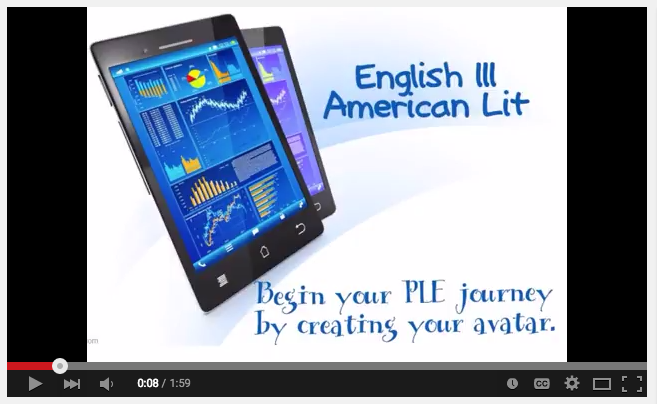
Task 3 asks students to create a multimedia presentation for use in instruction. As I work to build the new content for my 1:1 English III American Literature Class, I decided to create a video to guide students through the creation of their personal avatar using Bitstrips on their school-issued iPads. This task will be assigned to students the first day of class as the avatar is used on a daily basis to monitor progress on a visual bulletin board on display in the class. Additionally, students will use their avatar and the Bitstrips App itself for a variety of classroom assignments throughout the year. The video for this lesson has been uploaded on my class page and can be found at https://www.youtube.com/watch?v=P-6-NV8nP5g.

Planning the Video

Instructional Purpose

Austin-East Magnet School of the Arts is a 1:1 school where all students have been assigned iPads and all teachers are expected to find some manner of incorporating them into the class curriculum. English III, however, piloted the iPads and now operates in a Personalized Learning Environment with limited whole class instruction. To help monitor progress, student avatars are clipped onto the current module in the course. Additionally, students will use their avatars to demonstrate mastery of specific skills and concepts on a variety of assignments throughout the year. Therefore, the purpose of this lesson is to guide students to create a personalized classroom avater using Bitstrips. This application was selected as it is exciting and always changing, hopefully engaging students in the curriculum like never before. Learners in the lesson will consist of 125 juniors enrolled in English III. Technological skills of these students is somewhat limited as there is no formal technology class, though the students have had access to the iPads during the previous school year.

Concept Mapping

            Before creating the video, I created the lesson plan and determined how I wanted to create the video. First, I listed out exactly what I needed to include in the lesson. Then, I created a powerpoint file with slides for explaining the objective and the steps of the task based on what I generated in my planning. I also included a sample of my Bitstrip and how the avater would be beneficial to me as a student within the content of the slides as well. In scripting my voice over for the lesson, I used a graphic organizer to track key details I needed to include. Finally, I decided it might be helpful to include a few screenshots of the process of creating the avatar on Bitstrips. To get the screenshots, I reset my account on Bitstrip so that I could start from the beginning and have pictures of what the students would actually see during their process. I have been creating videos for classroom instruction for a while, so I planned my video using the same graphic organizer I have used at Austin-East.

Objective: Through the use of Bitstrips, the student will be able to create a personalized avatar for monitoring progress and completion of future classroom assignments.Steps:

1. Students will download and install the app.

2. Students will create the avatar.

3. Students will submit the avatar through Canvas for grading.

Slide/Screen Image Description/Notes/Scripting
Intro Slide Welcome to the course; general purpose of creating the avatar to guide the PLE.
Objective/Steps Read objective to students as expected by TAP guidelines. Transition into a review of the steps to complete the lesson.
Step 1 – Screenshot of app in the app store. This will help ensure students are getting the right app. Also, students will be instructed to pause the video here, continuing after the installation of the app.
Steps – 2/3 Continue with explaining students will create the avatar and submit it to Canvas for grading.
Meet Bitstrip Steph~ Avatar

~ Picture of Module Progression

Show my Bitstrip as an example, including images of the purpose of the avatar.~ Module Progression – Point out that the images are the lessons and the things hanging on the bottom are the avatars to signal where students are in the lesson.
Sample Bitstrip Assigmnet Show sample of a final product using Bitstrips.
Screenshots of Avatar Creation Include screenshots to let students see the process of creating the avatar once in the application. This helps get students excited about all of the options they will have for creating the avatar to resemble them as closely as possible.
Closure Slide Remind students they can ask for help at any time.


Creating the Video: Process Explanation

Once I had the plan, the powerpoint slides, and the screenshots, I began to create my instructional video using Explain Everything. I selected this application because it is the easiest screencasting application I have found while working to flip my classroom. While the process followed may seem confusing at first, the icons make the application a fantastic method for building and editing videos that can easily be shared to Youtube.

Step 1: Import the powerpoint slides into a new project.

The easiest way to import the powerpoint slides is directly from email. After creating the powerpoint on my computer, I email myself the file. On the iPad, I open the powerpoint. Once the powerpoint is open, I hold down the icon to open the file with a specific program and select Explain Everything. When Explain Everything opens, the program defaults to creating a new project with the incoming images.

Step 2: Add any additional images or slides desired.

To add slides, I simply clicked the plus sign on the bottom left of the screen. This area shows the total number of slides in the film strip. After the powerpoint, I was starting with nine slides. When I added the screenshots from the Bitstrip app, I needed two more slides. To add the screenshot of the app store, I navigated to slide three and added a slide there. To install the desired picture, I clicked the add button from the left menu. When the add option menu opened, I selected to add from existing photos. This opened my camera roll so that I only needed to touch the desired photo to add it to the slide. Once added, a photo editing menu bar appears. I enlarged the image to fill the screen completely and moved on to working on another slide. At this point, I was ready to add the screenshots of actually using the application so students would know what to expect. For this, I decided I wanted to add all three images on the same slide to save time. To do this, I went to the tenth slide and click the plus sign to add a slide. On the new slide, I again selected the add button from the left, navigating through adding from existing photos and selecting the images from my camera roll. To save time, I included only four images: the main entry image for gender selection, the first screen to pick the facial shape, the menu of categories for creating the specific looks and accessories for the avatar, and the final approval of the avatar. Having all of my slides entered into the project, I was ready to begin recording the voice over.

Step 3: Record the Voice Over.

To record the voice over, I kept my planning guide on the screen of my laptop while working from the screen of my iPad. Starting at slide one, I touched the red circle that signals the record button and began talking. When I was finished with the slide and ready to go to the next slide, I clicked the pause button before advancing the slide. I find the pause button before advancing the slide is a helpful step in case editing is needed to individual slides – you don’t have to worry about cutting off in the middle of a sentence or cutting the audio too close because the extra second pause gives the time to make the splits and adjustments if they are needed. Because I operate the video just as I would in the classroom, though, I also use the writing tool for emphasis. On the slide with the screenshot of the app store, I used the writing tool to circle the app I wanted students to download. On the slide where I show the examples of how the avatar is helpful, I used the writing tool to underline the avatars that were hanging on the course module display to draw emphasis to their presence.

For each slide, I follow the same process of recording, playing it back, and moving to the next slide. When I find I don’t like the way a slide sounds, I simply record over the audio and start fresh. To do this, I select the button to show audio and pull the cursor over to the zero on the audio timer. The screen automatically verifies the desire to film over the existing script, and once affirming this action I am able to record the slide again. Once I felt like each slide was where I wanted it to be, I held down the play button for a few seconds to make the magic play button open. The newly created play button is slightly larger than the stationary button on the screen because it allows the video to play in its entirety for once more preview before uploading or exporting the video. After watching my video, I realized I just barely made it under the two-minute maximum and decided I was ready for publication.

Step 4: Publish the video.

Publishing the final product in Explain Everything is also very easy. To publish, I simply touch the export icon on the lower right of the screen. A new menu option opens that allows me to select the method for sharing. I selected Youtube, and another menu opened up for me to add the name of the video and set the viewing status. I named the video for the task, and I set the video to public. From here, the work is done because the application automatically exports and uploads the video to my Youtube channel. Upon completion, the application opens a prompt with the link of the video and an option to automatically email the link. Out of habit, I email the link to myself and then click the link to verify the video has finalized correctly.

Benefits of Preplanning

When I first started making videos for my students, I did not take the time to create an outline of what I was going to say. This led to rambling in the videos, making the videos longer without any real reason for the length. Students would disengage from the videos, and I would tire of the hours waiting for the videos to export and upload. Then there was the challenge of storage. Creating an outline of the video was a natural progression that helped to make the whole process flow and produce a better final product with clear expectations and concise communication to the students.

When I am recording the video from my iPad, I have my graphic organizer outline of the video on the screen of my computer so that I can use it as a guide. Creating a plan for the video helps ensure the purpose of the video is met without leaving out vital details. Specifically considering this assignment, I knew I needed to get through the video instruction in less than two minutes. By planning the slides of the video in advance, I only included the bare minimum needed for the purpose of helping students create the avatar. By planning the description of what I was going to say, I was able to get directly to the point of the slide and not take too much time. By having the plan in front of me while working, I was able to stay focused and produce a clear video in a fraction of the time I would have taken otherwise. The greatest benefit I find, however, is that when I have created a thorough plan and reflect on the plan while working on the film, I stick to the plan, I say what needs to be said, and I don’t have to spend a large amount of time proofing and rerecording each individual slide.


References

Bitstrips. (2015). Bitstrips (Version 1.8.142). [Android Application Software]. Retrieved from https://play.google.com/.


Tagged , , ,