
Subscribe to continue reading
Subscribe to get access to the rest of this post and other subscriber-only content.
Subscribe to get access to the rest of this post and other subscriber-only content.
Subscribe to get access to the rest of this post and other subscriber-only content.
After a prolonged hiatus, I am thrilled to announce the revival of this educational blog! Life’s demands, continuing education, and the joys of raising young children took precedence over maintaining this platform, but the time has come to breathe new life into it.
What led me to revisit this blog after all these years? In short, it was persistent requests and encouragement from colleagues, fellow educators, and participants in the College Board-endorsed APSIs that I have had the privilege of leading in the last few months. Their eagerness to learn, grow, and connect inspired me to resurrect Kirk’s Corner as a collaborative space to exchange ideas and find resources for easy classroom implementation. I sincerely hope to create a space where teachers can find a wealth of resources and a variety of voices for instructional development and delivery.
Though the focus will predominantly be AP Language and Composition, this blog will serve as a hub for educators looking to enhance their instructional practices and empower their students in all classes and levels. From lesson plans and teaching strategies to assessment tools and professional development insights, this blog will offer a comprehensive range of resources to support teachers on their journey — and entries will be created based on reader requests. Recognizing the value of collaboration in the teaching community, I aim to foster a conversation through the blog’s comment section. I hope you feel free to use the comment section as an interactive platform — build networks, seek advice, and share resources.
It’s a new chapter. If you join me in growth, inspiration, and collaboration, our community will be one of passionate, dedicated educators who make a positive impact on the lives of their students.
…and lucky for me, the blog’s been holding a huge stash of drafted entries.

One part of Visible Learning that I love is student ownership of the process. In working on my Google Certifications, I found Kasey Bell’s Capacity Matrix. This was very helpful for me, and I wanted to try to use something similar in my classroom. I wasn’t certain how I would use it, so I started with the standards for the unit and had students review the elements and rate their learning at the start of the unit and at the end. This allowed them to reflect on their learning and revisit skills they felt needed more help.
For this year, I am going to start with having students use the skills matrix more intentionally with owning learning and progress monitoring. Creating the matrix was easy — I created a table and added in the standards and the rating system. In case you are interested, I wanted to share this matrix my students will be using to help with the NEW 2019 AP Language and Composition units. Full disclosure, this isn’t as pretty as some of my other charts, but I want to use this electronically for students to revisit it easily.
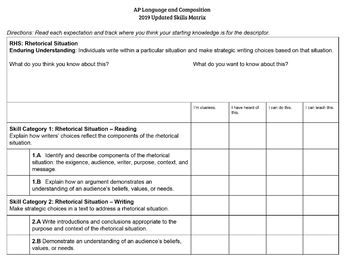
I know we can’t implement this matrix right now, but in a few weeks, students will grace our doors and we will be able to put it to good use. I’d love to hear how it works for you.
Each year, AP students are given a summer reading assignment. In the past, the one our school used was not the best, but this year, we listened to our students and we made a change.
What’s the plan? Concept Review.
The AP course comes with a level of analysis for a variety of texts. To help prepare students for seeing the differences, we asked them to refer to Chapter 1: “Using the Available Means” and Chapter 2: “The Art and Craft of Analysis” from our course text. Much of this introduction to the rhetorical situation and close reading had been in the curriculum throughout English I and English II, but one or two terms may have been new for some students. We then gave a guided notes handout to help students take notes on chapter information. How would this be checked? Well, since it is review intended to alleviate some of the “Summer Slide”, we just wanted to see handwritten notes.
However, we like to make sure we are doing what we can to help the students. We like to LISTEN to the students.
When students asked for a tutorial, I complied.
For students who are interested, I am creating a Nearpod to carry students through the vital skills associated with each chapter. We plan to release one each Monday for the next two weeks. Some slides have audio, and some activities were built in to help students remember the foundational skills. I even built in a few chances for students to tell us what they wanted us to know as we plan for return to the school year.
Would you like to see the LOC Chapter 1 Nearpod???
To participate as a student, click here: https://share.nearpod.com/vsph/ATUYrJJuNu
To download the presentation in your Nearpod library, click here: https://share.nearpod.com/e/YEZn6D0NmX
To preview, click here: https://share.nearpod.com/e5S1zD0NmX
Thanks for stopping by! Questions, comment, thoughts, or ideas? Let me know!
Do you EdTech? While working to be a Google Certified Educator, I have started a blog for that as well. Check it out here.
One thing is for certain: Writing can always be improved. This week, we are going to be making a short stop to focus on the rhetorical analysis writing in detail, one part of the paper a day. The goal is to remind students of the elements of strong responses so they are prepared to build this into their essays as a whole. Ideas? As always, I’m open to your thoughts.
MONDAY
Bell Ringer (15 minutes): Through the study of Litte Red Riding Hood, students will be able to monitor GUM and identify the meaning of unknown words.
Multiple Choice Monday: Through the study of an AP MC reading selection (Prestwick The Scarlet Letter AP Test Questions 1-10), students will be able to correctly answer the question, including justification for the selected answer.
Writing Workshop: Through the review of the rhetoric précis, the student will be able to write a thorough introduction including a thesis with vocabulary from the prompt.
Note: Student essays are evaluating the rhetorical strategies that Paine employs to accomplish his purpose.
HWK: Students will write two body paragraphs using information from their outlines.
TUESDAY
Bell Ringer (15 minutes): Through the study of Litte Red Riding Hood, students will be able to monitor GUM and identify the meaning of unknown words.
Thesis Statement Tuesday: Through the review of the three types of thesis statements, students will identify what their thesis statement is and use this to organize their paragraphs.
Writing Workshop: Through the review of TIQA and incorporating quotes, the student will be able to write body paragraphs for the analytical essay.
Writing Workshop:
NOTE: Short share out for T is track common errors on the board.
Reflection Closing: What errors do you commonly make? How can you work to correct these errors in the future? What TIQA-related changes did you make? How can this process help you writing the final body paragraph?
HWK: Finalize the body of your essay.
WEDNESDAY
Bell Ringer (15 minutes): Through the study of Litte Red Riding Hood, students will be able to monitor GUM and identify the meaning of unknown words.
Writing Wednesday: Through the study of The Art of Styling Sentences and the specific review of patterns 1-3, students will be able to write thorough and concise sentences.
Cohesive Conclusions: Through the study of concluding paragraphs from actual AP essays, the students will be able to identify critical attributes of an effective conclusion and demonstrate mastery by writing an effective conclusion.
Time Permitting, students will peer review the conclusion paragraph.
Closure: Finalize your essay to submit before class tomorrow.
THURSDAY
Bell Ringer (15 minutes): Through the study of Litte Red Riding Hood, students will be able to monitor GUM and identify the meaning of unknown words.
Tutoring Thursday: Through the study of AP Rhetoric, students will be able to correctly identify and explain the given device in the task cards. (Mastery 8/10)
I: Student are given 10 minutes to review the academic vocabulary associated with the excerpts on the task cards. This is designed to help reteach missed skills, and definitions of unknown words are encouraged for learning outside of class.
D/Ap: Students will rotate through stations to complete a minimum of ten task cards each for a grade. Mastery = 8 of 10.
Visual Rhetoric: Through the study of comics and visuals found on released AP exams, the student will be able to analyze the image to create a logical conclusion.
HWK: Take a break. If you did not submit your essay today, you BETTER have it tomorrow morning.
FRIDAY
Bell Ringer (15 minutes): Through the study of Litte Red Riding Hood, students will be able to monitor GUM and identify the meaning of unknown words.
Free Response Friday: Through the review of the student-created essay, students will finalize and submit the rhetorical analysis essay.
Sunday News, Monday Views: Through the study of current events, students will be able to rhetorically analyze a chosen article from the weekend news.
~Note: This assignment is weekend homework due at the start of EVERY Monday.
Monday – President’s Day: No school for students.
Tuesday – I was out, but the students had an amazing Zaption lesson to complete. Have you used Zaption? Seriously. Best. Ever. There is a cost, but if you open a trial through my account you can get two FREE months of the professional version. This is WAY better than the normal trial. Join Zaption for FREE with your TWO MONTH account – even just to explore – by clicking this link http://zapt.io/ruem93kaf .
Students review the Zaption video lesson and take notes on the rhetorical devices they have been missing in class, including a compare and contrast of the devices they are commonly confusing.
Activity: Assessment is built into the Zaption lesson, but students are to review the three devices labeled in “The Declaration of Independence” and increase the total number to 8. However, they may NOT use diction (because it is modeled in the video) and they may not repeat any device.
Wednesday
Bell Ringer: Through the study of Litte Red Riding Hood, students will be able to monitor GUM and identify the meaning of unknown words.
Hidden Agenda: Building background for allusion
Bell Ringer: 15 minutes
Caught ‘Ya (L11.1-3)
Etymology (L11.4-6)
~ G/AF: Sentence Corrections with guided questions with assigned weekly partner
~ Share outs (based on pacing)
Quick Review: Through the review of Rhetorical Devices in the text, the student will be able to analyze specific examples of rhetorical devices.
Review: I will set the timer for 10 minutes to review the devices found in the text. ONLY DEVICES MENTIONED BY STUDENTS WILL BE DISCUSSED. The purpose is to help where needed, not to give the answers.
Syntax: Through the study of Syntax 101, students will be able to identify and analyze the syntax of “The Declaration of Independence”
Syntax 101:
O: Ss will REVIEW syntax definitions in order to understand what is being evaluated with the term “syntax” is given.
D/App: Students will practice identification throughout the scaffolded lesson.
Model: Syntactic Analysis of “The Gettysburg Address”
You Do: Students will analyze the syntax of “The Declaration of Independence” by applying the guided questions from the lesson.
Closure: Think about your answers and T’s answers. What do you notice? What did you do well? What changes might you need to make?
Reflection Closure: Thinking about the week’s learning on syntax. How does the learning that results from Writing Wednesdays connect to syntax? How does this affect the audience?
Thursday
Bell Ringer: Through the study of Litte Red Riding Hood, students will be able to monitor GUM and identify the meaning of unknown words.
Hidden Agenda: Building background for allusion
Bell Ringer: 15 minutes
Caught ‘Ya (L11.1-3)
Etymology (L11.4-6)
~ G/AF: Sentence Corrections with guided questions with assigned weekly partner
~ Share outs (based on pacing)
Tutoring Thursday: Through the study of USA Test Prep’s personalized ACT review lesson, students will be able to show growth of 10% in a student-selected testing strand.
Note: This activity is mandated by the school for the 60 minute study block of Tutoring Thursday.
Cycle 3: Through the study of The Crisis, students will be able to identify and analyze rhetorical strategies in “The Crisis”.
HWK: Students should identify and analyze 8 different rhetorical strategies within the text.
Friday
Bell Ringer: Through the study of Litte Red Riding Hood, students will be able to monitor GUM and identify the meaning of unknown words.
Hidden Agenda: Building background for allusion
Bell Ringer: 15 minutes
Caught ‘Ya (L11.1-3)
Etymology (L11.4-6)
~ G/AF: Sentence Corrections with guided questions with assigned weekly partner
~ Share outs (based on pacing)
Essay Review: Through the review of the elements of an essay, the student will be able to create an outline for a rhetorical analysis of the text.
Activity: Students will review the Zaption video to review components and complete the assessment over what goes in an essay and how to ensure sufficient, relevant, and thorough evidence.
HWK: Have a thorough, full-sentence outline at the start of class Monday.
Between absences, delayed schedules, extended pacing, and surprise assemblies, class plans seem to always go astray. So, here’s the way Week 2 really worked:
Monday went on as planned. Multiple choice Monday appears to be a great idea. I used questions 15-24 on the 2007 released practice test. I gave the students 15 minutes, but I secretly paused the timer to give 20 minutes. Each question was worth 5 points, and they had the option of selecting only one answer for a shot at the full 5 or giving two answers for a shot at 3 points. Students then were to reflect on how they decided to answer the questions and what scores they gained. This strategy worked well because students do not lose points for incorrect answers, and narrowing it to two means they have tried and increased their odds. They were told to use the “Letter of the Day” strategy for the final two minutes, but I noticed students didn’t do that. Next week we are going to readdress “Letter of the Day” and focus on doing a preview of the questions to help provide a purpose for reading and annotating the passage.
Tuesday went decently well. We used BAT the prompt, and students seemed to understand that if I’m scoring it and I am telling you to do this, then maybe you should do what I suggest. Thesis statements and identifying the correct response or even what to write about was a struggle, and I’m going to need to focus on that moving forward.
Wednesday it went astray. Big time. If you don’t know your subject and verb, a sentence pattern is nearly impossible to get. I ended up having to complete an impromptu lesson on subjects and verbs, scaling back to focus only on the base of pattern 1. This took much more time than anticipated, and when student frustration ran high, I swapped to a very short focus on diction in Lincoln’s address. Analysis of diction went over much better than sentence patterns. First, students read and annotated for understanding. Next, they were to look over their notes and identify words or groups of words that stood out. From here, they identified the words/phrases as positive, negative, or neutral. Finally, they have to identify the overall perspective based on the diction they identified.
Thursday during tutorials, I had students take a quiz to match the figurative language term to the examples. I knew they had not studied the vocabulary from last week, so I prepared task cards giving the definition of the term in a complex manner. This will appear in the TPT store as a growing bundle soon. Hopefully this weekend, but I have two kids and my (eegads!) Christmas stuff MUST come down now.
During class, I decided to bring sentence patterns back. I wanted to do it through some other skill we needed to work on, so I scrapped my plans and did something completely different. Thursday because the less-than-alliterative Visual Rhetoric Sentence Pattern Practice. I found a few cartoons and had students apply guided questions to analyze them. The answers were written, and then a final response had to be written to one of the four sentence patterns. We repeated this with a total of five, one for a model and then a we do before independent practice. Students were told to mark the subject and verb, including vertical bars between the sentence parts. Mastery was much higher this time around, and I created a plan for tomorrow to make sure they have it. For the last bit of class, we revisited Lincoln’s speech and identified and justified overall tone from looking at the diction that was chosen. This created a perfect opportunity to look at a shift in the passage and how that might affect the audience.
For Friday, I noticed I didn’t update the objective on the weekly plan, but that was okay because our day went astray again. It was one of those days where something happened and the students were really struggling, so I had to scale back and revise. For pattern practice, I gave the students five sentences and instructed them to mark the sentence parts and then identify the pattern. Once they did this, they were to create their own sentence of the given pattern. This worked very well, and mastery of the creation was much higher than before. In reviewing student work, however, this is because they used the same sentence and changed names or simple details. In my mind, this is cheating, but I didn’t give any kind of direction that they could not do this. Who knew that would be the result? Next we moved into a discussion of an article they will be using for a guest lecture next week. The students were to read and annotate the article. Next, they got with a partner to discuss the article. For homework, they were to create the Toulmin Model of the text, identify specific examples of diction and overall tone, and then respond to, “Is this right?”
Not sticking to the intended plan was rather unavoidable this week, but I hope next week will be better. It is a short week as a result of the holiday, they will have the diagnostic placement testing for the semester, and we have the guest professor lecture of an overview of ethics. This should give me time to post some of my resources on TPT.
Any suggestions to help me push students toward a higher level of academic achievement? I welcome your feedback.
 Kirk's Corner